Wednesday, November 17, 2021

Covid-19 Winter - The 4th Wave

Winter is coming... again. A 4th wave of Covid-19 is hitting Europe and is likely to impact the United States in the coming weeks.

As we can see below, countries in Europe are now setting daily case count records since the pandemic began. This comes even as vaccination rates have climbed to around 70% on the continent according to the European CDC (Link).

What can we take away from this recent uplift?

  • Reinforces the idea that there will be a "flu-like" surge of Covid-19 each winter moving forward.
  • ~70% vaccination rates in the population do not prevent large scale outbreaks of Covid-19.
  • There is no singular solution to combatting this virus and ending the pandemic. We need to continue the fight using multiple tools, including:
    • Vaccines
    • Anti-Viral drugs (Pfizer's new covid-19 pill is great news on this front: Link)
    • Social Distancing
    • Increased hygiene across the population


Saturday, March 21, 2020

Covid-19: The Coming Employment Crisis

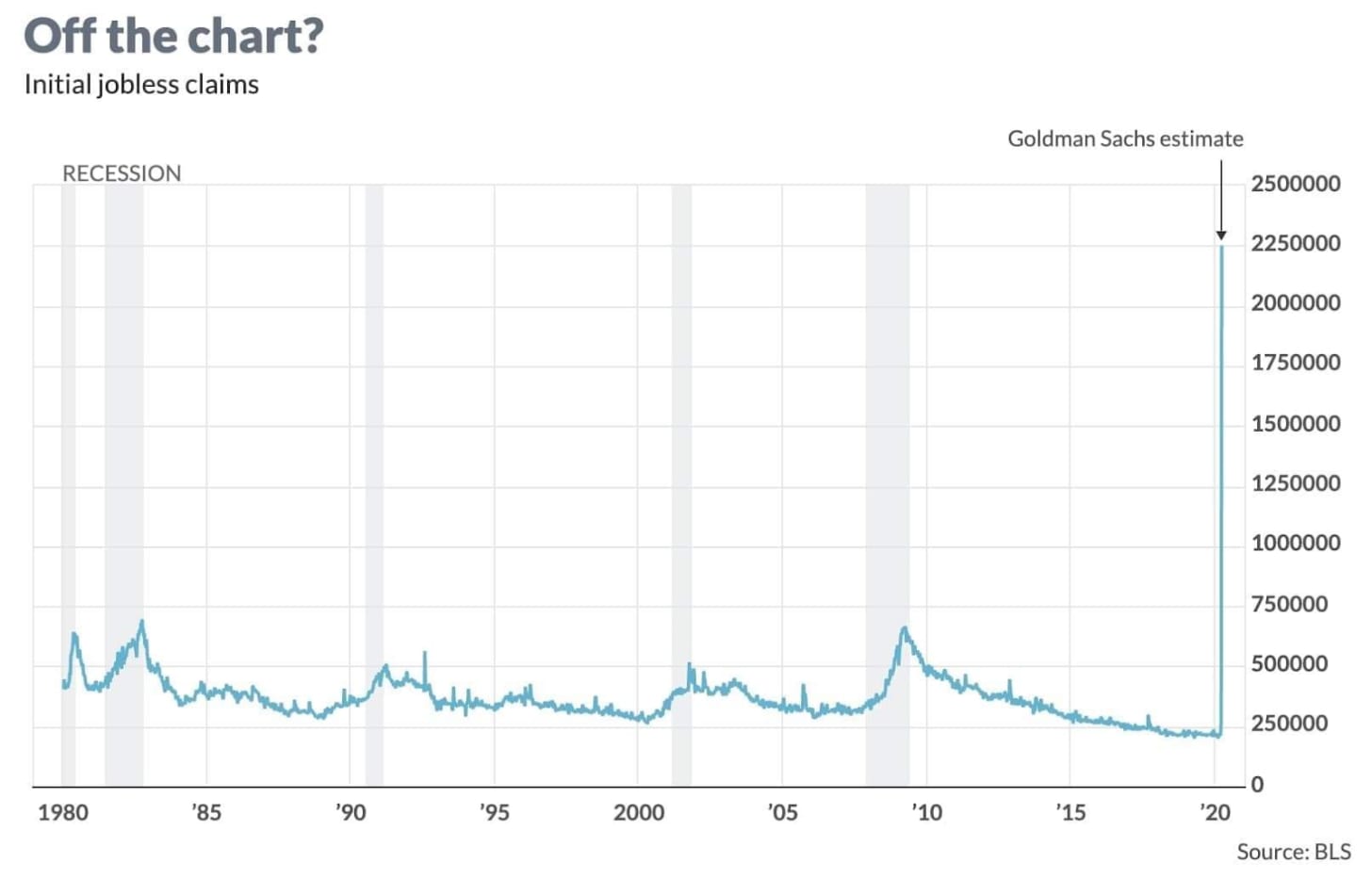
The impact of the pandemic hitting the global economy is unprecedented. Let's look at one data point in particular, employment. One facet of the post 2008 financial crisis expansion has been a slow but steady increase in employment. Covid-19 brings an abrupt end to that.

As you can see below, estimates are that within two weeks, the US will have around ~2.25M initial jobless claims. For comparison, the prior all-time peak topped out at ~695,000 Americans two years into a recession in 1982. The speed of this crisis is breathtaking.


Policymakers are now faced with an enormous crisis; keep people healthy while also keeping people employed. Sending out an immediate $2,000 to each person is a good start.

Monday, April 8, 2019

McDonald's Acquisition of Dynamic Yield - Software Continues to Eat the World


Last month, McDonald's made headlines by announcing it's largest acquisition in over 20 years, dishing out $300M for seven year old Dynamic Yield. A noteworthy move by the fast food giant that requires a second look:
Below listen to CEO Steve Easterbrook speak about the acquisition:


Items that stand out:
1. Mass personalization as opposed to mass generalization is the future of the service industry. No two menus will be the same, each customer will see entirely different ordering options much the same way two users see different Google search results now. This applies to all customer facing applications... on mobile, at a self order kiosk in a physical store, or on the drive thru.  

2. Software continues to eat the world. Algorithms replace repetitive human labor. What was once run entirely by labor intensive humans will not be digitized. The future looks something more like: Driver A's autonomous vehicle moves into McDonald’s drive through lane, a video monitor recognizes the car license plate or face of the driver. Software then quickly determines the personal preferences favor healthy options and there is only one occupant in the car. As the vehicle approaches the ordering screen, the menu will display salad options more prominently. 

3. Buzzword BINGO will never die. Listen to the video above to hit your letters... 'intelligent menu boards' / 'data mining' / 'digital platform' / 'personalized experience' /... even Amazon got a name check! 


Below is the original article written by Marc Andreessen in 2011:                                                       "Why Software is Eating the World"

Friday, March 1, 2019

Update: Federal Reserve Balance Sheet


During Fed Chair Jay Powell's testimony this week, it was made clear that the Fed Chair is looking to walk back comments made in December 2018 that the balance sheet reduction was on 'autopilot'. This comes just months after Powell first made the ‘autopilot’ statement and equities responded with a torrid sell off, falling close to 20% before ultimately bottoming on Christmas Eve. 

This turn around can lead investors to a couple of conclusions. First, the FED clearly takes into consideration ‘financial conditions’ or more likely, equity valuation / stability. The FED put, initially thought lost during chair Powell’s first few months, is alive and well. Second, the financial sector and the economy as a whole are less able to absorb a tightening of monetary policy than previously thought. 

Throughout 2018, there was substantial discussion that the FED balance sheet runoff was going smoothly, that the economy was humming along, with some commenting that the global economy was expierencing ‘synchronized global growth’. The below chart shows how far the FED has moved, after growing the balance sheet by over $3 Trillion, just ~$400B has rolled off. Relative to the increases, this was nothing and yet markets roiled up, volatility spiked, credit spreads were widening, and liquidity all of a sudden was being talked about as a risk. Economic growth may have even slowed as result, as businesses and consumers, concerned at the equity volatility, delayed spending / business investment in Q4. Now, the FED appears to have backed themselves into a corner on the balance sheet. The party’s back on, so let’s get up and keep dancing.


Monday, January 8, 2018

Photo Post #9: Roosevelt Island, New York NY

Panoramic View of Manhattan from Roosevelt Island, January 2018. © Chris Besserer


© Chris Besserer

The view of Manhattan from Roosevelt Island. Temperature, 5 degrees Fahrenheit.
© Chris Besserer

© Chris Besserer


Wednesday, September 13, 2017

Photo Post #8: Montreal, Canada


Montreal street photo after New Years Eve snow, 2016.

© Chris Besserer

Wednesday, December 14, 2016

Google 2016 Year in Review


I find this video fascinating every year.... Enjoy.


And for reference, here is 2015 in review:


Tuesday, August 2, 2016

Amazon should purchase Ticketmaster or Live Nation

Amazon buying a ticketing service provider may seem odd at first glance. Yet, below I will explain why there are benefits to an acquisition of this kind. If Amazon were to purchase Ticketmaster (Parent company is Live Nation), it would be able to leverage the existing ticket distribution service to bring in more revenue and target more specific customer needs through the newly obtained customer data.


First, visitors to Ticketmaster and Live Nation sites will now redirect to Amazon.com/Ticketmaster or Amazon.com/Tickets. That way, additional traffic is directed towards the online marketplace. In 2015, Live Nation processed 530 million tickets, which is substantial traffic. Amazon.com is currently in the top 5 of sites visited in the USA. I am sure Jeff Bezos would like to see them as the #1 site. “The Everything Store” would gain an additional piece to that puzzle, a portal for live sporting events, concerts and more. Within the ticketing section, there will be links to merchandise for those same events. This leads to the next big benefit of the acquisition.

Customer Data. Amazon wants to know as much detail about its customers as possible. With the addition of a ticketing service, users will link their Amazon accounts to their ticket purchases. Amazon will now know what concerts, sporting events, or plays you like to attend. That information will enable Amazon to directly target products to individual customers based on music tastes, sporting tastes and so on. As time goes on, Amazon will understand who your favorite teams, what games you go to and when, and then be able to offer you deals on select merchandise heading into a football season, or into a game that they know you will be attending.

A scenario plays out where you log onto Amazon.com/tickets and purchase two tickets to the upcoming Knicks game. On the way to the cart, offers will pop for a Knicks hat, or a Carmelo Anthony jersey. Of course, free shipping is included with Prime. Certainly you are more likely to purchase that merchandise than someone that isn’t about to attend a game. This plays into Amazon’s strategy of being able to cater to customers on a personalized level. For the next two weeks leading into that game, Amazon can target specific products to you.

At a current market cap of $5.5 Billion, an acquisition of Live Nation will be a rounding error for Amazon. They could even purchase Ticketmaster from within Live Nation for less. This would be just another piece to the puzzle of becoming the “Everything Store” that Jeff Bezos has envisioned. Lastly, I haven’t mentioned the benefit of acquiring the ticketing business itself, a sector that has a long runway to grow considering the preference of live sporting/concert events that the younger generation has.

Wednesday, July 13, 2016

Pokemon GO: Potential Revenue for Nintendo

Nintendo shares are on fire after releasing the earth shattering, augmented reality "Pokemon GO" game this past week.


Thinking about this from a financial perspective, I will quickly summarize a potential revenue stream for Nintendo from the game.

Retailers and fast food chains can have Nintendo make their location an important stop where players can find rare items or Pokemon or whatever else is important to gather in the game. I'll save the specifics of what they need to have because I don't play the game myself, but I do understand there are certain locations that are important for players to visit. Stores can become that location and players would have to visit those stores to go further in the game. 

For example, this upcoming weekend, Wal-Mart may run a special that has their store give a higher chance of catching a rare Pokemon in the game. Nintendo charges Wal-Mart a fee for setting up a virtual Pokemon catching ground in their store for the weekend and Wal-Mart benefits by increasing foot traffic to the store and getting more potential customers inside the doors.

This could be any company, all over the world. It will be interesting to see how the augment gaming evolves over time. Yet, one thing is for sure, this will not be the last augmented reality game that takes the world by storm.

Monday, June 27, 2016

Alan Greenspan on Brexit

90 year old Former Fed Chairman Alan Greenspan speaking on the recent referendum in the United Kingdom. Greenspan believes Scotland will go for Independence next, and Northern Ireland is a maybe. Contagion is a key issue markets will be focusing on in the weeks ahead. Was Brexit a one off event, or part of a broader dissolution of the European Union?


Thursday, June 23, 2016

Photo Post #7: Newport, Rhode Island

I spent the previous weekend in Newport, Rhode Island attending a cousin's graduation. Below is a picture I took of the harbor, though it was cloudy. Newport is a beautiful town that combines it's old history with a newer, people friendly downtown that has plenty of shops and restaurants to keep you busy.

© Chris Besserer


Thursday, April 21, 2016

Starbucks: Second Quarter Earnings after the Bell

Starbucks earnings are out after the bell today. I believe if earnings come in below expectations, this will be a great buying opportunity for long term investors. One concern for potential investors right now may be the high p/e multiple, currently around 37 times earnings.

However, long term, the strong growth from Starbucks will continue to impress. The company is pushing hard into China and Greater Asia with the market in China now the second largest for Starbucks, behind only the USA. CEO Howard Schultz has said the company plans to open 500 stores in China, every year for the next five years. Clearly, management is looking to take advantage of the growing incomes there. For those investors who may be doubting coffee culture in China or the rise of the consumer would be mistaken. This past March, when I was in China, every Starbucks I passed was jam packed. Now, before you dismiss an empirical observation, the numbers confirm what I saw, fourth quarter revenues in Asia doubled year over year for the company. Rising incomes in the region and the growing emergence of a middle class will only continue to drive top and bottom line growth for Starbucks.

With further expansion plans into South Africa and Italy, Starbucks growth is not tapped out and will continue for the company. This is without mentioning the loyalty program, increased mobile app usage, and the continued innovation in the stores with wireless charging and free wi-fi in stores. 

Starbucks is currently valued at $90 Billion and I wouldn't be surprised to see news headlines in the future highlighting how Starbucks has passed McDonalds (valued at $110 Billion) in terms of market cap. The arches are parting way for the green apron. 


Wednesday, April 13, 2016

Fitbit: The True Oppurtunity

On news that a Fitbit has helped save a man's life and with the stock being up over 10%... Today I want to talk about the true potential of Fitbit.

Right now, Fitbit is a fitness company. The company has a focus on helping people get in better shape. The social platform allows users to interact and compete against each other. However, the great opportunity for the company lies beyond fitness, it is in overall healthcare and corporate wellness programs. 

A Fitbit may help insurance companies save money. If people wearing Fitbit devices lead healthier lifestyles, insurers may pay out less in health care costs in the long run. Health insurers may begin subsidizing Fitbit devices to their customers. After all, just a few days ago it was reported that a Fitbit saved a man's life. The doctor was able to utilize data from the Fitbit to administer medical treatment properly.

I see three points of focus for Fitbit to transition further into being an overall healthcare company.

1. Greater analytics & appealing visual dashboard

2. Statistically proven health benefits of the device

3. Increasingly accurate sensors

Fitbit is doubling R&D spending for this year. CEO James Park has mentioned they view themselves as a "digital health and wellness company" and 2016 will be a year for increased
"software improvements, more algorithms, and coaching". This speaks beyond getting people up and running more, he is looking beyond the hardware and seeing what these devices can tell us. 


Analytics provided to healthcare insurers can help them understand how a Fitbit leads to a healthier lifestyle, what level of activity or heart rate can lower the chance of heart disease. Actionable insights from Fitbit will force the hand of insurance companies. It will become clear that they must find a way to get these devices into the hands of their customers. At that point, not only will sales from the physical devices soar but also Fitbit will begin to monetize additional aspects of the business. The data and analytics they provide can be monetized. 

Of course, for all of this to occur, the sensors on the devices must improve. It's a safe bet that Fitbit engineers are working hard to do just that. If you believe that this is a possibility, it may a worthwhile investment while the company is valued at just over $3 Billion. After all, the healthcare sector is a $1 Trillion plus business per year.


Tuesday, April 12, 2016

Book Spotlight #6: The Organized Mind


"The Organized Mind"

By: Daniel Levitin


Quote Highlight: "The global economy means we are exposed to large amount of information that our grandparents weren't. We hear about revolutions and economic problems in countries halfway around the world right as they're happening; we see images of places we've never visited and hear languages spoken we've never heard before. Our brains are hungrily soaking all this in because that is what they're designed to do, but at the same time, all this stuff is competing for neuroattentional resource with the things we need to know to live our lives."          - Daniel Levitin


Do you ever feel as if the world is spinning faster and faster? This feeling that your life is increasingly flying past your eyes and you can't seem to put a finger on why. If you find yourself thinking “this must be new, it’s only just yesterday that everything seemed to move slower,” you may be correct. Daniel Levitin, a neuroscientist at McGill University, uses his knowledge of human cognition to explain why this now common phenomenon may be taking place.

This feeling that time is moving faster, of us humans being tired and forgetful is not ephemeral. It is real and it hinges on the new information age we have recently created. As Levitin explains, our brains were hardwired thousands of years ago, to focus on tasks that required concentration. Where to locate food, where to find shelter, these were important things for our brain to remember. Today, our brains are much more likely to remember driving directions than your Facebook password. He goes on to explain that our brains are becoming overwhelmed by all the information that is insistently pushed into our laps. Levitin brings in stories and humorous examples to take the complexities or neuroscience and simplify it so the reader can better understand what is happening.
Everything from old times to the rate at which our brain can process information. Speaking to one person, our brain processes 60 bits out of a possible 120. Trying to talk to two people at once, is barely doable. Once a third enters the mix, our brains become overwhelmed, and the only possible way to conversate is to switch between tasks, in this case, between speakers. Levitin goes on to explain that if we think we are multi-tasking well, think again. What we are actually doing is switching between different tasks extremely quickly. An example that shows this to be true occurs when you are driving down the highway. As you drive, you chat with friends in the car, but as your exit approaches, you quiet down and you may tell your friends in the car to quiet down as well, or you instinctively turn down the radio volume. This is your brain attempting to focus on taking the exit. It cannot multi-task effectively enough to find the exit while driving 70 mph, talking to your friends, and listening to the radio all at once. You need to concentrate on one task. Once you are formally on the exit ramp, you turn the radio back on and begin chatting again.

This cognitive phenomenon, that our brains are hardwired to concentrate and not to multi-task, may be why we feel so tired at the end of the day. Today, society is built around multi-tasking. People are texting, watching TV, talking, surfing the web, and playing a mobile game all at the same time. Let’s imagine a common scenario, you get home from work and sit down to watch the latest Netflix original series. As you begin to watch, your smartphone buzzes, it's an email notification. You ignore it but then it quickly buzzes again, this time a text, you write back and glance back at the TV. All the while Netflix is playing. Then another alert pops up on your phone, Lebron James just finished the game with 40 points, thank you ESPN app, now back to Netflix. And this loop continues throughout the waking day in some form or another. As much as you think that in this scenario you are multi-tasking, it isn't. This is ultimately what is making us feel tired and overwhelmed by ordinary everyday life. Your brain is being overly taxed. There are millions of distractions and notifications every minute of the day.


If all this is bad, what is driving our incessant need to check our smartphone or social media apps? Levitin explains how our brain gets a hit of dopamine each time we look at the phone. Thus, we are actually rewarding ourselves for becoming easily distracted. This becomes a sort of negative feedback cycle. The more distracted you become, the more your brain craves dopamine and ever more distractions ensue. At the very end of the day, you find yourself exhausted at all the work your brain has been doing at switching between tasks all day. This proves to be invaluable insight into the effects of the modern communication age. The future of new technologies remains uncertain, but this book allows us to at least understand what is happening to our brain and attention at a scientific level.


This book was very enlightening to read and I personally took to heart the idea that less is more. Technology is great, so long as you can harness it for good. Levitin offers all types of advice to stay organized and stay on task in today’s world. Some of his ideas I will definitely look to implement into my own life such as setting aside certain times of the day for different activities. At a certain set time, leave all distractions behind and focus on that task. Whether it is to clean your room, answer emails, workout, read a book… whatever. Only that task should occupy you. Turn off the television, put away the phone. If you’ve heard this advice before, Daniel Levitin proves with neuroscience that it is good advice. Find the book on Amazon here.


Friday, April 1, 2016

Tesla Model 3: 115,000 pre-orders within 2 hours


Last night, Tesla finally unveiled its planned electric car for the masses, the Model 3. The presentation was reminiscent of early Apple launches, with people lining up outside the company stores just for the right to put a $1,000 deposit down on a car that they had not even seen yet. 

The most striking aspect of the presentation was how Elon Musk began by talking about climate change. Before even mentioning the car or showing it off, he put up two graphics on the screen. One, showed carbon emissions from the beginning of time to present day. The other, showed how global temperatures are rising over time. He then spoke about how this car is important to the future of humanity; that it is important for the world to switch away from the internal combustible engine and to clean electric transport.

The take away from it all... this company is about more than just a car. Tesla is selling a powerful idea, an idea that they are the ones that will stop climate change. They are going to bring clean transportation to the masses, and on top of that, it will be done with a great car. A car that has the ability to run software updates wirelessly and plugs in to charge just like your phone. Buying a Tesla means you will never visit a gas station again. Musk finished off by thanking the 650+ Model S and Model X owners in the audience for their purchase, telling them they helped to fund the Model 3. Again, the belief that a purchase of a Tesla is about something greater than just a car. Your purchase of a Model S helped save the planet by funding the low cost Model 3. Now, your purchase of the Model 3 will help stave off climate change. 

Whether right or wrong, this belief has already helped Tesla build a tremendous cult following. It is this fervent belief in Elon Musk's dream that may help propel the company to the top in the years to come.

Wednesday, March 30, 2016

Wearables & Personal Health Data

Recently, the viability of wearable devices has been put into question. Both pundits and consumers alike are asking themselves, "What is the point?" with many calling the devices a "fad". This question is a valid concern, for after all, what does it mean to when users learn they walk 10,000 steps in a day, have a resting heart rate of 60 beats per minute, they slept for 7 hours 50 minutes last night, or see that they gained 6 pounds over the past 3 months?


Latest Fitbit lineup of wearable devices


I can understand these comments. Consumers want products to be simple and easy to use. Right now, these users are questioning whether these devices have a purpose beyond nudging them to exercise more. Let us take a look at the current user interface design for Fitbit:


Here is a chart of my resting heart rate over the past month.


Looking at takes some time to see what is going on. First, I can see clearly that on weekends my heart rate is lower, presumably I am more relaxed. On the 15th of March I was quite stressed at work, which was followed by a week of elevated heart rate. The precipitous decline shows the result of when I made a tough decision. In the future, I think Fitbit will make it easier to ascertain why your heartbeat is above or below normal levels, and suggest ways to adjust your behavior accordingly. Patterns may emerge, for instance, if you exercise 30 minutes per day, your heart rate may show you in a healthier range. If you eat certain foods or follow a certain diet you may see the corresponding results in your heart rate. Right now, the data is not intuitive, patterns don't jump out at you. That will change over time.

Next, Sleep Data.


Again, this gives almost nothing of true, useful value at first glance. It's nice to see how much you sleep, or how little you are sleeping. Although one thing I have found interesting, is that people have found out that they suffer from sleep apnea after they purchased a Fitbit by being able to see how many times they were restless at night. Moving forward, I think that the medical profession will be able to pinpoint certain disease onsets by studying user sleep patterns.

Wearable technology is about more than counting steps and working out. The next step is automatic data analysis for doctors to use and for each individual to have a personalized health assistant. Companies like Fitbit or Apple now need dedicated teams of scientists and doctors to analyze, link, and come up with suggestions based on the user's health data that these devices are capturing. Sleep trends may be correlated to caffeine consumption, stress, or overall health. The timing and duration of weight loss or weight gain can signify the onset of an illness. Our resting heart rate over time may be useful in trying to predict and prevent heart disease. We are just beginning to see this take shape. To count out wearables as nothing more than expensive pedometers is a mistake.

It reminds me of noted economist and NY Times writer Paul Krugman, who penned an article in 1998 in which he claimed... 


"By 2005 or so, it will become clear the Internet's impact on the economy has been no greater than the fax machines."

It is easy for people to be dismissive of new technologies. People may disregard many transformative ideas right up until the point they become mainstream. Wearables today may feel bulky and redundant to your smartphone, but they are becoming mainstream. Continuous improvements will allow these devices to gather valuable insight about ourselves that will help us all lead happier, healthier, and ultimately longer lives. 


Monday, March 21, 2016

Wednesday, February 10, 2016

Fitbit & GoPro

Four quick reasons why Fitbit is NOT GoPro... so don't trade like it.

1. Executive Pay. The CEO and CFO of GoPro have sky high compensation packages. In fact, CEO Nick Woodman was the highest paid CEO in 2014. He even bought himself a fancy new yacht for about $40 million (Source). Compare that to CEO James Park of Fitbit who receives a modest $300,000 salary and has claimed that "Growing Fitbit is his life goal" (presumably sailing around on a $40 million yacht doesn't fit in with that goal). Some executives IPO their companies to cash out, while others look at the IPO as an opportunity to gain additional funding and grow the company further. The difference here is clear. The CEO of GoPro used the companies IPO to buy himself a yacht, while Fitbit's CEO is looking to make strategic acquisitions to grow the company.


CEO of GoPro was making $10 million more than Larry Ellison of Oracle. Executive pay is barely behind that of Satya Nadella, CEO of Microsoft, a company with a market cap 400 times that of GoPro. 


2. New Product Launches. GoPro has not come out with a significant new product since the Hero 4 series launch in 2014. Fitbit has announced a watch (the Blaze) and a new revamp of one tracker line (the Alta) for March launch. Continuous new product initiatives will help Fitbit maintain it's market share lead in wearables. On the other hand, GoPro has been caught by competitors, and it seems only marketing is keeping them ahead of the competition in the short term. 

3. Data/Software & Social. Fitbit is focusing on becoming a health company. The data they collect from users will be used to increase the health of those same users. Data is king in todays world, and CEO James Park has said that 2/3 of R&D is spent on software. That's a great sign and proves Fitbit understands that the company's true value is beyond just the hardware. True value comes from what they can tell users and how an analysis of the health data will lead to healthier lives of its customers. Fitbit's $50 per year premier membership for additional user data insights is a good step in that direction. This differs drastically from GoPro which offers little value beyond the camera hardware. The video editing software that GoPro provides has little intrinsic value to consumers who have many options in the space. Software and social aspects are an important way to rope consumers into a growing ecosystem, something Fitbit is clearly focusing on. Due to network effects, the more people that purchase a Fitbit, the more valuable it becomes for others to get one  as well. 

4. Financial Strength. Fitbit has been a profitable company for some time now and has near 0 debt on the balance sheet. Conversely, GoPro turned a loss in it's latest quarter, a holiday quarter nonetheless. Not many new tech IPOs are able to turn a profit so early, Fitbit has been an exception and looks to be in good shape on the financial front.

Ultimately, fears of Fitbit facing a similar demise to GoPro are overblown. Do not be surprised to see a decoupling of the stock price correlation. Fitbit's future is much brighter than GoPros and the market is sure to figure that out in time.

Monday, February 1, 2016

Data Review: Housing Prices by Region versus Median Household Income in the USA

Housing affordability remains a key issue in the USA right now, with home ownership declining to levels not seen since the 1960s. 

Let's take a look at housing prices over time and compare a chart of the median household income over time. One is rising significantly while the other is falling. These are two factors that may help explain the fall in home ownership rates. 

The median home price is split by geographic region. As you can see, if the housing bubble burst in 2008, you'd be hard pressed to see that reflected in prices. Housing prices are now higher than they were during the peak of the "bubble." It appears that the FED has done an excellent job re-inflating home asset values. 


Data courtesy of U.S. Department of Housing and Urban Development 


Next we can look at real median household income. Asset prices are easier to inflate than salaries. Household incomes are at levels from 1997. Americans have the nearly same real median household income as 20 years ago.


Data courtesy of St. Louis Federal Reserve.

Saturday, January 16, 2016

Fitbit Blaze & the Need for Speed

Fitbit recently announced it's newest product line, a smartwatch deemed the 'Blaze'. Similar to the Apple Watch in looks, the Blaze touts 5 days of battery life and a strict focus on fitness features. CEO James Park talked up the "style" of the watch and wants Blaze owners to have a simplified user experience. Not only does it look like an Apple Watch, the CEO is starting to sound like an Apple executive.  Investors were left unimpressed with the product and the words, the stock has shed over 30% since the announcement.


                   The Apple Watch                                 vs.                                   The Fitbit Blaze


According to investors, the two years of resources Fitbit spent developing the Blaze may have been better used elsewhere. Though consumers seem to have a different opinion than investors. The watch went on to win multiple awards at the CES show it was unveiled at. Now valued at 30 times earnings, investors are expecting bigger and better than just the Blaze. I believe current worries about Fitbits future lie not with the Blaze, but with two other things.

Before going into what needs to be improved. I need to clarify that I am bullish on the Fitbit's future and the future of wearables in general. Here is what I think Fitbit does have going well for it right now.... 

1. The brand name and beneficial network effects of controlling 85% market share.
2. Increasing use of Fitbit in corporate wellness programs
3. The social appeal (Challenges, Forums)
4.. Potential monetization of user health data analysis... the $50 per year Fitness Premium is moving in this direction.
5. Growth of overall wearable markets (The pie continues to grow)


Now, there are plenty of quick software improvements that will make existing customers more involved. Here are the two improvement areas that Fitbit investors should be more concerned and excited about...

1. The slow pace of software enhancements
2. The lack of lineup refresh. 

CEO James Park has touted that Fitbit has never had a bad quarter, indeed the 8 year old company has consistently turned a profit and has little to no debt. That cannot be said for plenty of other companies that had IPOs in 2015. And it is a great foundation for the company to build on, but moving forward the company needs to move faster, and the insistent on maintaining profitability in the short term may be holding the company back and allowing competitors to catch up. Apple, Under Armour, Microsoft and others that have expanded into the wearables market all have deeper pockets. Growth is key to maintaining the edge for Fitbit. Fitness trackers are not a fad, people do truly love quantifying their workouts. As the current leader in market share, Fitbit needs to continue improving and continue innovating or else others will quickly catch up.

Software should be a #1 priority for Fitbit. The company does have a forum entirely dedicated to new software Feature Requests. Browsing through the posts, you can quickly spot posts by customers who love their Fitbit, but want it to be able to tell them even more. Some requests are listed below.


- Additional challenges beyond steps and daily challenges. Something like adding in a 1 hour workout challenge, or a monthly calorie challenge etc...


- Better sleep analysis, possibly combining sleep with heart rate analysis to gain additional understanding of our sleep patterns. A better user interface.


- Adding exercises like push-ups/situps and cycling
- Idle Alert to buzz you when you've been inactive for a certain period (post has been up since 2013)
- Alarms that can wake you up naturally based on your sleep pattern (post has been up since 2013)

Even very a simple addition like adding new clock faces have been left untouched. What are software engineers doing at the company?

Additionally, I think Fitbit should be investigating the potential for bands that can track heart rate or blood pressure. The heart rate monitor is not as accurate as it needs to be, as recent class action lawsuits show. Bands with sensors would help incorporate even greater levels of accuracy.


There are plenty of ways for Fitbit to keep moving forward. An emphasis on software and an entire lineup refresh with better sensors is monumentally important. The current challenge feature, the ability to add friends and communicate about your workouts throughout the day is a major differentiator from other fitness trackers. Investing in hardware is important, but the ecosystem of Fitbit needs to be greatly expanded and utilized much more effectively to fend off competition. A moat needs to be built to keep users from jumping ship so easily if cheaper competitors exist.


Ultimately, I think Fitbit is a buy at it's current level of $17-$18. They clearly had a great holiday season, backed up by being the #1 downloaded App on the Apple App Store over Christmas. The company is off to a fast start, but now it needs to put it all together.